Tonight the ambient temperature was 23 degrees, exactly the same as when I did the datalogging and testing of my old A2W system last year. So, it was a perfect chance for me to do a direct comparison with my new A2W system.
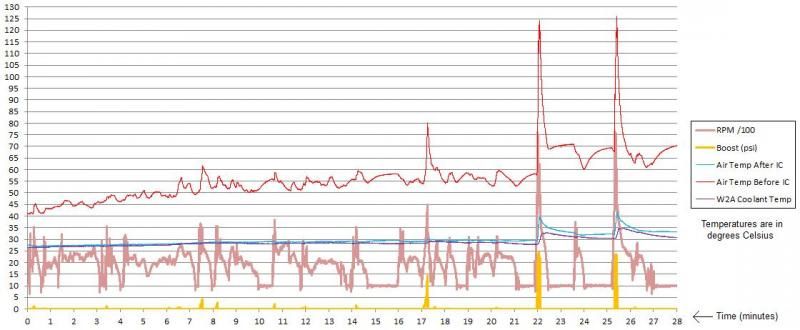
Here are the results with my new A2W intercooler system:
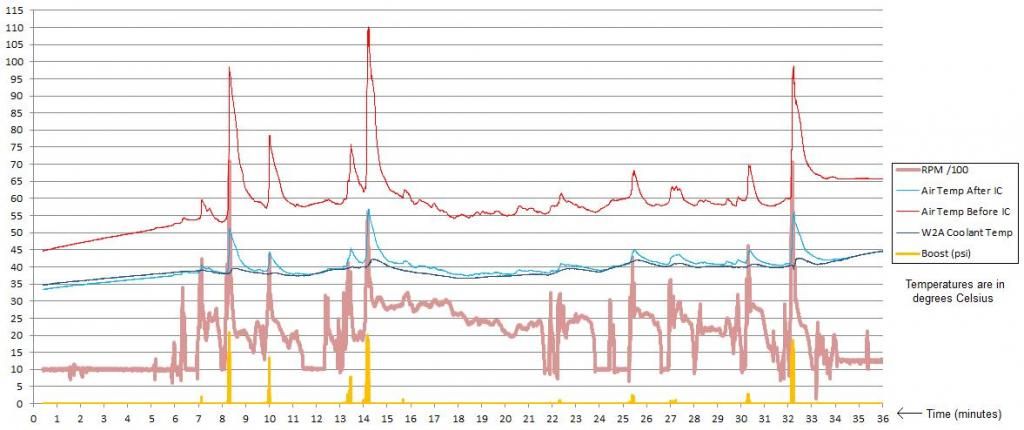
Here is the graph from last year with my old A2W intercooler system:
I am very pleased with the results, the improvement is even more significant than I expected it to be!
- In the old results, there are 3 main boost events at 8, 14 and 32 minutes in the log.
- In the new results, there are 2 main boost events at 22 and 25.5 minutes in the log.
- In the old results, the worst-case air temp before the intercooler was 110 degrees C (after a few seconds at 20psi of boost), which was reduced down to 57 degrees C after intercooler.
- In the new results, the worst-case air temp before the intercooler was 125 degrees C (after a few seconds at 24psi of boost), which was reduced down to 41 degrees C after intercooler. This is a great improvement! The pre-intercooler temperature was 15 degrees higher, but the post-intercooler temperature was 16 degrees lower!
- In the old results, for the first 6 minutes (and at least another 5 minutes before the log started), I was idling in the garage while mucking around with some unrelated ECU settings, and during this time the A2W coolant temperature heat-soaked from 23 degrees C all the way up to 38 degrees C (due to having the heat exchangers in the engine bay previously), which is terrible.
- In the new setup, the heat exchanger is up the front of the car so the A2W coolant temperature barely moves, and is only about 4 degrees above ambient temperature. In the worst case on full boost, the temperature was only about 8 degrees higher than the steady-state temperature, and it dropped pretty quickly afterwards.
- After the first full-boost event in the new results, I was forced to sit there idling almost immediately afterwards, and the second full-boost event was only a few minutes after that.
- As forum member 'cogs' clarified last time, the slow decay rate of the temperature sensor readings in some low-throttle cases is a result of the thermal inertia of the sensors, rather than an accurate representation of the temperature. When on boost with heaps of airflow over the sensor, the reading IS accurate though, because the additional airflow causes the sensing element to heat up quickly.
The way that both of these tests were done, it obviously doesn't indicate what would happen at the track or driving through twisties in a spirited fashion for minutes at a time, but it certainly shows that the system is perfect for street driving where there is normally plenty of time for the A2W coolant to cool down between high-boost events.
Anyway, if the test was done during more continuous spirited driving, the heat exchanger would be getting more airflow the entire time. I'm confident that the system will still perform well when put under more stress. The temps will probably go higher, but I expect that they will remain totally reasonable.