2018/07/08 08:13:22
mr2pete
You shouldn’t have to remove the manifold studs to remove the assembly.

I’m also about to also put a new gasket on my engine. Not sure what the besr brand gasket is to use.
2018/07/08 10:36:49
maccardo94
Im finding with leaving the vertical and horizontal studs all in. Theres no way i can get it out. Also im buying all me new studs and gssket from primedriven. Heaps of good mr2 stuff

Sent from my CPH1725 using Tapatalk

2018/07/08 15:44:58
maccardo94
Ok so im going ahead removing the manifold,turbo and dp off i one peice as recomended. What is the best way and which end is best to remove the hard lines to the turbo as pictured

Sent from my CPH1725 using Tapatalk

2018/07/08 19:45:13
stuka
The middle section of the stud you mention is the 'shoulder' where the stud 'seats' in the cylinder head. Doesnt matter if these come out with the nut as you undo it.
 
Im not sure how well you have examined what you have been doing before you dive in, dont forget there is an oil feed hard line from the cylinder block to the underside of the turbo, dont forget to undo this before you try to remove the turbo assembly.
2018/07/08 21:40:49
maccardo94
Yes dw i know im far ahead of myself with this. Its my first major work. Just learning as i go. Going to replace the dp with a berk one while im there also with a berk exhaust system. Il keep than oil line in mind. Im at a point where i cant re assemble it easy enough to take it to a mechanic. So it has to be done haha.jokes on me

The car isnt a daily so i have the time to work on it


Sent from my CPH1725 using Tapatalk

2018/07/09 08:02:02
stuka
Good on you for giving this a go, take your time and you will be alright. Do you have a copy of the workshop manual BGB PDF? It should have diagrams of the turbo and ancillaries in there.
 
If you don’t undo the turbo oil feed hard line you will be in sorts of strife and you will end up damaging/bending it. This is the combined hard pipe that also returns oil to the sump, it would be easiest to undo the banjo bolt from the block. It’s a big one, maybe 32mm but cant remember exactly.
2018/07/09 10:14:01
maccardo94
No i dont have the pdf. Where can i find this? Also should i drain the oil lines. Or plug them up when i remove them. Or are they only pumping when the engine is going if that makes sense

Sent from my CPH1725 using Tapatalk

2018/07/09 12:13:21
stuka
Im not sure where you download it, someone else on here might know.
 
The oil lines drain when the engine is not operating
2018/07/09 13:03:26
Mrskylighter
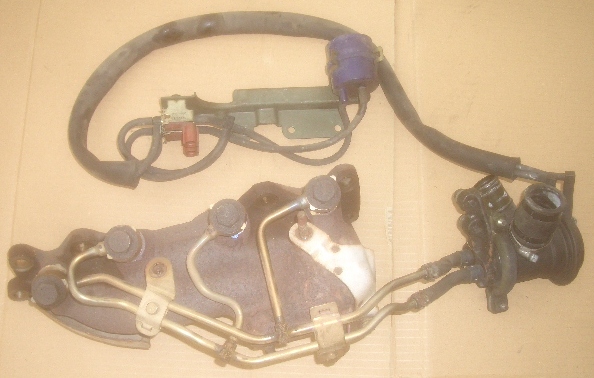
The manifold you have is somewhat rare. It is from a Celica GT4 Group A Rallye/ WRC anti lag setup. 
 
Here's a pic of the complete setup. It is not is use on the production car though. Just fitted for Homologation purposes.


http://gtfour.supras.org.nz/homologation.htm
 
Anti-Lag
The Group A was the first production car I know of with anti-lag standard, although again not operational. The system uses an ECU signal to switch two VSV's on the back of the block which provide vacuum (via a canister) to the special bypass valve fitted right beside the entrance to the IC. This heavy duty metal valve has a poppet valve which when opened directs some of the air (which usually all goes through the BOV) down four metal tubes into the exhaust manifold. A special manifold has a hole just after each exhaust port. A small heatshield sits between the manifold and the intercooler.
 
How do you make it work? You don't.
 
Anti-lag is *very* hard on turbos due to the shockwaves and high temperatures produced. Unless you have a rally team budget, forget it.
 
Here is some of what you need to do to activate it. My bypass valve seems to be jammed shut, maybe it has an internal spacer to stop it opening. The fittings connecting the pipes to the manifold are also not drilled though. With those aspects fixed the system will mechanically work. The VSV's are wired to the ECU, however an aftermarket ECU is needed to apply 12V to make them work. I'm guessing that (like most systems) the ECU retards the timing while continuing fuel injection. The mixture burns in the manifold, keeping the turbo spinning. This is very harsh on the system, therefore the pipes are just to supply cool air to keep temperatures down (conjecture!).
 
 
2018/07/09 19:56:22
maccardo94
Awesome good stuff! Nice research too

Sent from my CPH1725 using Tapatalk

12 - Powered by APG vNext Trial
© 2025 APG vNext Trial Version 5.5

Use My Existing Forum Account

Use My Social Media Account